
Fuites du masque PPC : comprendre la gêne et retrouver du confort
Un souffle au bord du masque, une bouche sèche ou un sifflement sous PPC ? Repérez les fuites, faites les vérifications utiles et sachez quand contacter votre prestataire.

A useful home sleep study starts with clear instructions, a reasonably typical night and an accurate account of what happened. Wearing the equipment overnight does not guarantee that every signal can be interpreted.
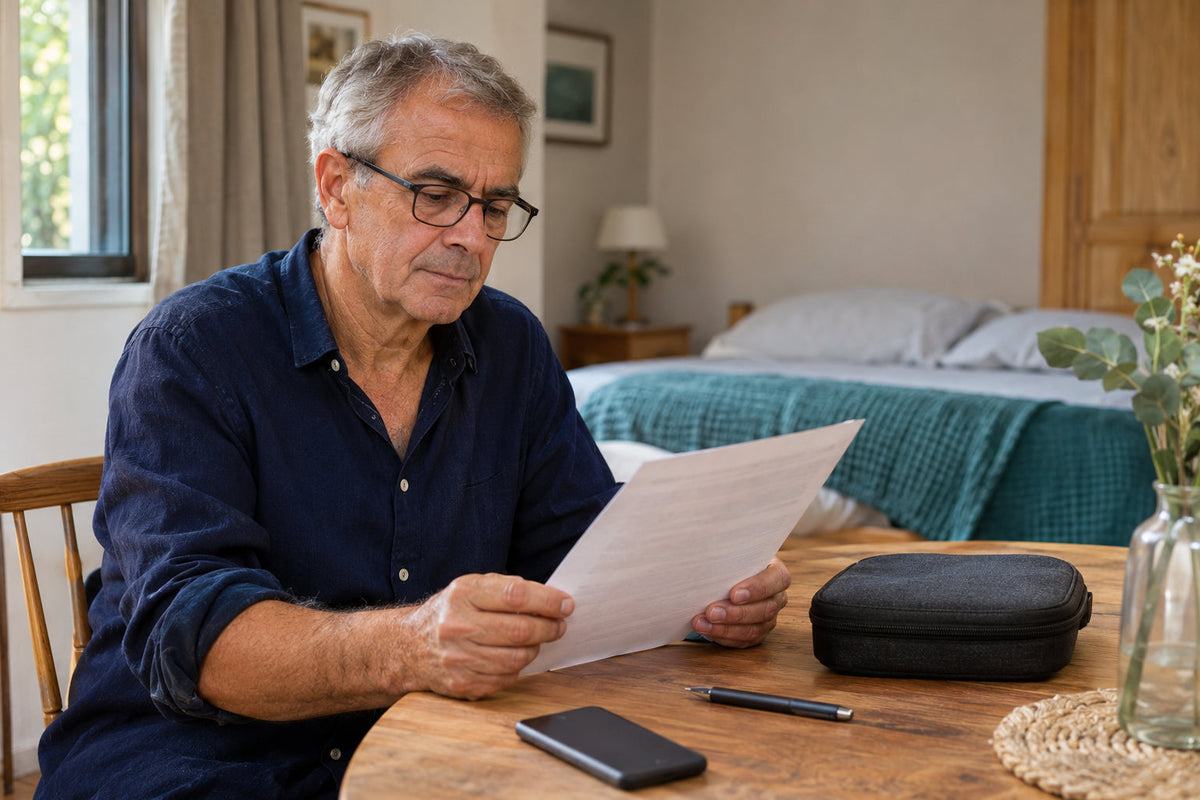
Photographic-style contextual illustration created for this guide.
SLEEP INVESTIGATIONS
The equipment can feel more daunting than the test itself. Your task is not to produce a perfect night’s sleep: it is to allow breathing to be recorded in your normal surroundings. These practical steps help you prepare and make the results appointment more useful.
A home respiratory sleep study records signals such as airflow, breathing effort and oxygen saturation, depending on the prescribed equipment. It helps identify breathing events overnight. The doctor selects this investigation for your symptoms and circumstances; it is not a universal assessment of every sleep disorder.
Respiratory polygraphy and polysomnography. Polysomnography adds signals that identify sleep and its stages, including brain activity. A conventional respiratory study does not record these signals, so it does not directly measure how long you actually slept.
Marked difficulty falling asleep, certain associated illnesses or unusual symptoms may change the choice of investigation. Mention them before the appointment rather than choosing what seems to be the most comprehensive test yourself.
When the equipment is handed over, ask for a demonstration and explain the steps back to the professional. Knowing a sensor’s name matters less than knowing what to check at bedtime. Placement, activation, indicator lights and permitted adjustments depend on the model and the service’s protocol.
Before you leave
Mention adhesive allergies, difficulty using your hands, significant nasal blockage or a need for help from someone at home. The installation can then be planned without improvised solutions later.
Prepare the equipment early enough to avoid rushing, in the conditions specified by the team. Follow their advice about washing, skin preparation, clothing and any products to avoid. Do not infer a fitting method from a video showing a different recorder.
Keep your usual routine as far as possible. Do not deliberately shorten the previous night to make yourself sleepy, and do not take an extra sedative to make the test easier. Do not drink alcohol to make snoring more apparent. Ask the prescriber what to do with your regular medication; do not stop anything on your own initiative.
If you already use CPAP, a mandibular advancement device or oxygen, clarify exactly how the test should be performed: diagnosis without treatment, assessment with treatment or another purpose. Deciding for yourself may make the result difficult to interpret. Our practical questions before a sleep study provide additional preparation.
Waking up, going to the toilet or finding a sensor uncomfortable does not mean the entire test is lost. Only reposition equipment in the way you were shown. Do not add tape, change connections or restart the recorder at random. If you are unsure, use the instructions or contact provided.
In the morning, describe what you noticed: “finger sensor removed towards morning”, “awake for a long time after going to bed”, or “very blocked nose”. An approximate time is enough if you happen to know it; there is no need to watch the clock overnight. Do not try to reconstruct precision you cannot reasonably provide.
Your account helps the professional relate recorded traces to the night you experienced. They can distinguish discomfort, signal loss and periods with usable data. The result is not a judgement of how well you cooperated.
Imagine the recorder remained attached for eight hours, but you estimate that you slept for only five. These are different durations. When a respiratory event index uses a recording period longer than actual sleep, the result can be underestimated. Recording analysis methods vary, so the figure should be read alongside the report rather than on its own.
Night-to-night variation, sleeping position and signal quality also matter. A low value does not mean the same thing after a representative night and after a very short, wakeful or technically poor night. Ask how much of the recording was interpretable and whether the conditions allowed the original clinical question to be answered.
An incomplete study is not a negative diagnosis. If the data cannot support a conclusion, or symptoms remain strongly suggestive despite a reassuring result, the doctor decides what follows. Polysomnography may be appropriate; repeating smartwatch measurements yourself cannot replace that decision.
Return all components as instructed and hand over your overnight notes. Ask when the result will be explained and by whom. An automated export or screenshot of numbers does not replace medical assessment of the traces in the context of your symptoms.
Three questions for the results appointment
The patient pathway helps you understand the sequence. For practical support from the homecare provider, Valeosanté’s answers offer additional information alongside the medical explanation.
No: report how the night felt and any incidents. Some periods may still provide useful information. After checking the signals and clinical context, the team can decide whether the study answers the question or another investigation is needed.
An indicator light or displayed number does not establish a diagnosis. Ask for the interpreted report and a results appointment. Do not change treatment on the basis of raw data.
No. The test mainly investigates breathing and does not measure every cause of disrupted sleep. Persistent symptoms should prompt a discussion with your doctor to reassess the clinical question.
Before the study, leave with clear instructions and a contact. Afterwards, provide straightforward observations. A useful outcome is an explained conclusion and an organised next step, including when the first night cannot settle the question.
References checked on 23 November 2026.
Written by PlanèteSommeil. This guide provides information and helps you prepare discussions with your care team; it does not replace an individual assessment.
Continue reading
Un souffle au bord du masque, une bouche sèche ou un sifflement sous PPC ? Repérez les fuites, faites les vérifications utiles et sachez quand contacter votre prestataire.
AirFit F20 and F40 are two ResMed full face masks: both cover the mouth and also allow breathing through the nose. Their main difference is the contact area: F20 covers the nose, whe...
Key message: sex, weight and the absence of reported snoring cannot by themselves rule out sleep apnoea. Persistent difficulties deserve assessment, without turning common symptoms i...
Find selection criteria, compatibility details and practical advice in our FAQ.
Sleep apnoea and screening


